
Codechamp optical encoders
Codechamp optical encoders provide exceptional angular accuracy for applications requiring precise and stable positioning.
ON RÉPONDS À VOS QUESTIONS
When should I choose an optical encoder for position measurement?
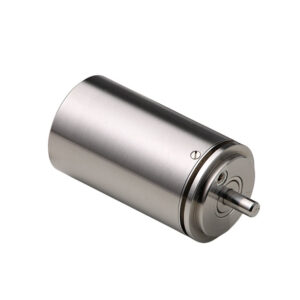
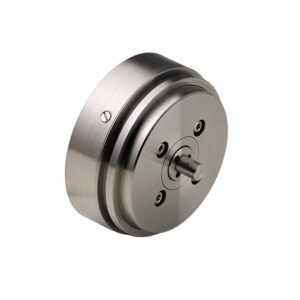
An optical encoder is particularly suitable when your application requires accurate angular measurement and digital position feedback. The Codechamp range includes single-turn and multi-turn absolute encoders, solid-shaft and hollow-shaft designs, and low-profile pancake configurations. Selection starts with three criteria: the required accuracy, useful resolution and space available for integration. These should be considered together rather than ranking products by bit count alone.
Accuracy indicates the stated position error of the sensor. It must match the application’s requirements. Resolution describes the fineness of the digital position coding: it complements accuracy but does not replace it. For example, the COA09-01 combines a 22 mm body diameter, resolution up to 21 bits and accuracy of ±40 arcseconds. The COA40-01 offers up to 25 bits and ±5 arcseconds in a 100 mm diameter hollow-shaft configuration.
Where space along the rotational axis is limited, the CAP40-01 and CAP50-01 provide two pancake options to consider. The CAP40-01 combines a 100 mm body diameter with a 13.9 mm thickness, resolution up to 23 bits and accuracy of ±5 arcseconds. The CAP50-01 has a 119 mm body diameter and a 16.5 mm thickness, with resolution up to 23 bits and accuracy of ±10 arcseconds. Mounting dimensions and required clearances must be checked separately against the integration drawing.
Finally, distinguish position within one revolution from revolution counting. The COM09-01 combines 21 angular-position bits with 4 turn-count bits; the COM23-01 combines 23 and 12 bits respectively. The additional turn-count bits do not improve angular resolution within one revolution. After this initial selection, check supply voltage, interface, speed and environmental requirements. Our team can help identify a configuration that meets the complete set of requirements for your application.
Can an optical encoder or potentiometer be used under high shock and vibration?
Yes. Several Codechamp optical encoder references have successfully completed shock and vibration testing. Optical technology should therefore not be ruled out solely because the mechanical environment is demanding. Selection depends on how the application’s loads compare with the validated test profiles for the particular configuration, rather than on a general assumption about the sensing technology.
Random vibration tests include levels of 39.4 g RMS in the axial direction and 39.5 g RMS in the radial directions for the COA30035, 21.4 g RMS for the COA60025, 29.58 g RMS for the COA78001 and 25 g RMS for the COA105001. The profiles cover the 20 to 2,000 Hz range. For the COA60025 and COA78001, the stated durations are two minutes and 150 seconds per axis respectively.
Shock tests are also defined by frequency-dependent profiles. For example, the COA30035 has a spectrum with a 430 g plateau from 700 to 10,000 Hz, with a Q factor of 10. These values must be interpreted together with their spectrum; they are not a simple peak acceleration that can be directly compared with a half-sine shock.
For our space potentiometer kits, the environmental specification calls for 46.5 g RMS for two minutes per axis during qualification and 38 g RMS for one minute per axis during acceptance, along all three axes. The stated criterion is survival without damage. These levels relate to that space configuration and should not be generalised to standard potentiometers.
To select your sensor, provide the spectra, durations, axes and mounting conditions. Also specify whether the requirement concerns mechanical survival, output continuity or measurement accuracy during exposure. The available test results must be assessed against the actual acceptance criterion required for your application.
What is the difference between resolution and accuracy?
Resolution describes the fineness of the digital measurement increment. For an angular encoder, it corresponds to the number of coded positions within one revolution. Accuracy, as stated in our product specifications, describes the error between the indicated position and the actual position. The two parameters therefore answer different questions: “How fine is the available position coding?” and “What position error is specified?”
A 25-bit single-turn encoder theoretically distinguishes 33,554,432 digital positions. The corresponding increment is approximately 0.039 arcsecond, calculated by dividing the 1,296,000 arcseconds in one revolution by that number of positions. The COA40-01 offers resolution up to 25 bits and stated accuracy of ±5 arcseconds. These figures are not contradictory: a signal can change in very small increments while still having a larger position error.
Increasing the bit count does not, by itself, correct measurement errors. Where an application requires accurate knowledge of absolute position, high resolution must be combined with suitable accuracy. Selecting only the encoder with the highest bit count can therefore overlook the characteristic that actually determines whether the measurement meets the application’s needs. Resolution should be treated as part of the specification, not as a substitute for accuracy.
Fine resolution can nevertheless remain useful for smooth servo control or detecting small movements, where noise and repeatability allow it. Repeatability describes the ability to obtain similar readings at the same position under the same conditions. It does not replace absolute accuracy either.
To select an encoder, first define the acceptable position error, then determine the required resolution. Compare dimensions and integration conditions next: useful performance is the performance your application can actually use, rather than the highest numerical specification considered in isolation.
Which optical encoder should I choose for a defence or industrial application?
Selection should connect the application with its accuracy, resolution and mechanical integration requirements. An application family provides an initial shortlist, but does not establish that a particular reference is suitable for every item of equipment in that family. The associated comparison table brings together the website references to support this assessment.
In our defence selection guide, the COA12 and COA15 are among the references proposed for seekers. For electro-optical and infrared systems, the COA09 and COA12 address compact integration requirements, while the COA40 provides a hollow-shaft architecture. The COA15, COA23, COM23 and COA34 are proposed as starting points for weapon-station assessments; the COA23, COM23 and COA40 are identified for radar systems. These associations are selection guidance, not general qualification statements covering every application within each category.
Other references help refine the compromise. The COA11-01 and COA13-01, with respective body diameters of 27 and 34 mm, extend the compact-format options. The COA23-02 combines a 58 mm diameter, 24-bit resolution and accuracy of ±7 arcseconds. The COA63-01 provides a hollow-shaft architecture with a 190 mm outside diameter, 25-bit resolution and accuracy of ±10 arcseconds.
For multi-turn measurement, consider the COM09-01 and COM23-01. Where the assembly requires a flat configuration, the CAP40-01 offers a 100 mm body diameter, a 13.9 mm thickness, up to 23 bits and ±5 arcseconds. The CAP50-01 combines a 119 mm diameter, a 16.5 mm thickness, up to 23 bits and ±10 arcseconds. Mounting dimensions and required clearances should be checked separately.
Final selection should retain the measurement performance required without introducing unnecessary installation space. After comparing these three criteria, confirm the interfaces and environmental capability of the intended configuration with our technical team before fixing the product definition for your equipment.
How should I select an optical encoder for a space application?
For a space application, select your encoder by comparing accuracy, resolution and the dimensions compatible with your mechanism. The Codechamp COA60, COA63, COA78, COA83 and COA105 space encoder families all use hollow-shaft, low-profile pancake architectures. They have their own dimensions and performance specifications, which should not be inferred from those of the standard CAP40-01 or CAP50-01.
Dimensions provide an initial selection criterion. The COA60 has a 150 mm outside diameter, a 45 mm inside diameter and a 23.3 mm thickness. The COA63 retains a 45 mm inside diameter, with a 165 mm outside diameter and a 31.65 mm thickness.
The COA78 and COA83 have respective outside diameters of 195 and 210 mm, inside diameters of 80 and 110 mm, and thicknesses of 33.05 and 32.2 mm. The COA105 has a 267.3 mm outside diameter and a 167.3 mm inside diameter; its thickness remains to be specified before integration can be finalised.
For measurement performance, the COA60 and COA63 provide 22-bit resolution, with respective accuracy figures of ±5 and ±7 arcseconds. The COA78, COA83 and COA105 provide 25 bits, with respective accuracy figures of ±5, ±3 and ±3 arcseconds. The stated repeatability is below one arcsecond for all five families.
Selection should also consider redundancy, which is indicated for the COA63, COA78, COA83 and COA105 in the configurations presented, followed by the mission’s environmental requirements. Our team can assess adaptations to meet your needs. Final selection therefore concerns a complete technical configuration, not simply the diameter or bit count considered in isolation.
Key performances
- Resolution up to 25 bits
- Accuracy below 3 arcsec (0.012 mrad)
- Error repeatability below 1 arcsec (0.005 mrad)
- SSI / RS422 output
Typical applications
- Space mechanisms: SADM, CMG, antenna and optical system pointing, scanners, radiometers, spectrometers, interferometers, sounders, scatterometers
- Radars
- Remote-controlled weapon stations (RCWS)
- Optronic systems for surveillance, reconnaissance and targeting
- Missile seekers
- Remote handling cranes in radioactive environments