
Semip potentiometers provide reliable and continuous measurements, even in extreme conditions.
WE ANSWER YOUR QUESTIONS
Which potentiometer should I choose for linear or angular displacement measurement?
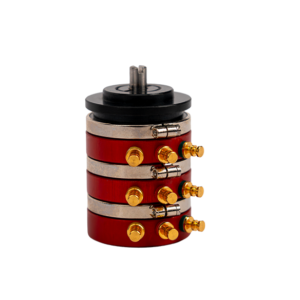
A potentiometer provides analogue position feedback and should be selected according to the movement, useful travel, linearity and available installation space. Semip offers four complementary families: conductive-plastic rotary potentiometers, single-track linear potentiometers, dual-track linear potentiometers and wirewound rotary potentiometers. Compare specifications for the actual reference and configuration required, distinguishing in particular between independent linearity and absolute linearity.
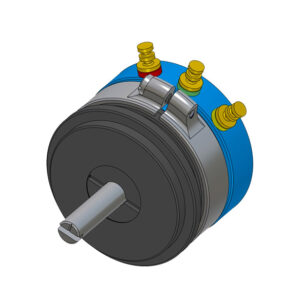
For angular movement, FTC-01 conductive-plastic rotary potentiometers cover diameters from 12.7 to 76.2 mm. Depending on size and configuration, electrical angles can reach 358° and independent linearity can be as low as ±0.05%. The stated temperature range is −55°C to +125°C. Configurations with multiple resistive elements are also available, with the options depending on the selected size.
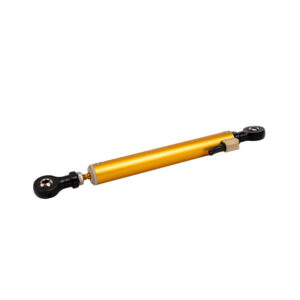
For linear movement, FTC-05 single-track potentiometers have a 9.52 mm diameter body and standard electrical travels from 15 to 125 mm. Standard independent linearity ranges from ±0.5% to ±0.25%, over 95% of total electrical travel. Versions down to ±0.1% are available on request for selected travels. The datasheet specifies IP66 protection and a temperature range of −40°C to +150°C.
The FTC-06 dual-track linear potentiometers, with a 12.7 mm body diameter, cover electrical travels from 10 to 125 mm and provide two position signals. FTC-07 wirewound rotary potentiometers offer electrical angles from 350° to 358° and absolute linearity down to ±0.05%, depending on the model.
Our conductive-plastic potentiometer technology has been qualified for 50 million cycles. This qualification provides an endurance reference for the technology concerned; its applicability to your requirements must take account of the configuration and operating conditions. Specify the movement amplitude, speed, temperature and electrical operating conditions so that a suitable solution can be defined for your intended duty cycle.
When should I choose a Hall-effect position sensor?
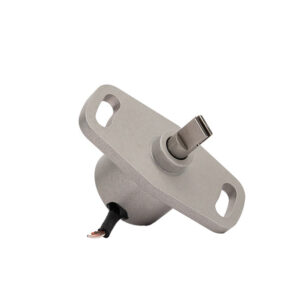
A Hall-effect sensor is suitable when you need angular measurement without a sliding electrical measurement contact, together with an output compatible with your electronics. The Semip range includes analogue, pulse-width modulation — PWM — and SSI digital versions. Selection should combine mechanical format, measurement range, linearity and output interface rather than considering the sensing principle alone.
The CEH111-1, CEH428-1 and CEH522-1 provide analogue outputs. Their measurement range is factory-programmable between 5° and 360°, with a standard resolution of 13 bits and stated non-linearity of ±0.25%. Selected options provide 16-bit resolution or non-linearity of ±0.07%, depending on configuration. The CEH111-2, CEH428-2 and CEH522-2 provide PWM outputs, with resolution depending in particular on the selected output frequency.
For an SSI digital interface, the EHE111, EHE428, EHE522 and EHE322 offer programmable resolution from 12 to 16 bits. Their standard non-linearity is expressed as an angle, at ±0.75°, rather than as a percentage; options at ±0.25° are listed in the catalogue. These figures should therefore not be compared directly with the percentage values of analogue versions. The catalogue also specifies a 10 kHz sampling rate and an input-to-output delay between 0.6 and 1.8 ms.
Temperature capability depends on the reference. The CEH versions presented cover −55°C to +150°C, while several EHE versions are limited to +125°C. The EHE322 with a cable has a specific range of −40°C to +85°C. Optional peak-temperature ratings should not be interpreted as continuous operating temperatures.
Mechanical arrangements and protection ratings also differ: some references are rated IP54, while others are rated IP68. Describe the mounting arrangement and operating conditions so that the sensor, output and options can be selected as a coherent configuration.
Key performances
- Linearity as low as 0.1%
- Hysteresis of 0.1%
- Service life of 1×10^6 cycles (40 rpm)
- Operating temperature from -55 to +200°C
- Operating temperature from -45 to +180°C
Typical applications
- Aircraft: actuators for control surfaces and fluid management systems (air, oil, fuel), as well as landing gear
- Formula 1 and rally cars: gearbox, camshaft, throttle control, steering wheel, accelerator pedal, front and rear dampers, front and rear wings
- Space mechanisms: SADM, robotic arms, thruster support arms